

Behind the Renovation: What It Takes to Transform a Resort
From the first assessment to the final finish, discover what happens behind a successful hospitality renovation.
When guests walk into a newly renovated resort, they see the finished result: refreshed spaces, new finishes, updated interiors, and a completely renewed atmosphere.
What they don’t see is everything that happened before that moment.
A hospitality renovation involves much more than changing the appearance of a space. It requires planning, coordination, technical expertise, careful execution, and the ability to work within an environment where every detail contributes to the guest experience.
At Cay Building, we understand that renovating a resort means transforming an existing space while keeping its purpose, functionality, and character in mind.
1. It Starts With Understanding the Existing Space
Before any renovation begins, the existing conditions need to be assessed.
Every building has its own history, materials, systems, and challenges. Understanding what is already there helps determine what needs to be repaired, replaced, preserved, or completely transformed.
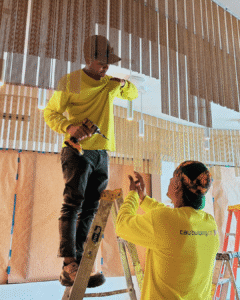
This initial stage can involve evaluating:
- Existing surfaces and finishes
- Structural conditions
- Electrical and plumbing systems
- Moisture or deterioration
- Existing architectural elements
- Areas requiring repair or reinforcement
A successful renovation starts with knowing what you’re working with.
2. Planning Around the Guest Experience
One of the biggest differences between hospitality construction and many other types of construction is the importance of the guest experience.
A resort isn’t simply a building. It is an environment designed for people to relax, explore, dine, sleep, and create memories. That means renovations have to consider more than the construction itself.
Scheduling, access, safety, logistics, and coordination all become particularly important when working within an active hospitality environment.
The objective is not only to transform the space, but to do so thoughtfully and efficiently.
3. From Demolition to Transformation
Once the project is ready to move forward, the visible transformation begins.
Existing elements may need to be removed or prepared before new work can take place. Walls, ceilings, floors, fixtures, and finishes can all become part of the renovation process.
But demolition is not simply about taking things apart. It is about creating the right conditions for what comes next. Every phase builds upon the previous one, which is why proper preparation is essential to achieving a quality final result.
4. The Details Behind the Finishes
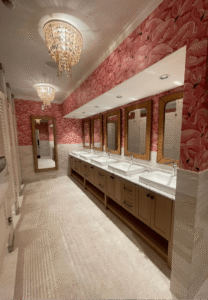
One of the most noticeable parts of a renovation is the finishing stage. This is where the space begins to look like the final vision: tilework, drywall, painting, flooring, wallpaper, cabinetry, fixtures, architectural elements, and decorative finishes all contribute to the final appearance.
But a beautiful finish depends on what happens underneath it. Proper preparation, measurements, alignment, installation techniques, and coordination between different trades all contribute to the final result.
The finish may be what people notice first, but the work behind it is what makes it possible.
5. Coordination Is Everything
A hospitality renovation rarely involves a single team. Different trades and specialists have to work together, often within the same space and according to a carefully coordinated schedule.
Construction teams, installers, painters, electricians, plumbers, finishers, and other specialists all have a role to play. When these teams work together effectively, each phase can move forward without compromising the next.
Great renovations aren’t built by one trade. They’re built through collaboration.
6. Working With the Caribbean Environment
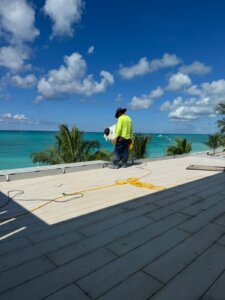
Renovating a resort in the Caribbean comes with another consideration: the environment.
High humidity, intense sunlight, salt air, tropical weather, and exposure to moisture can all affect materials and building components. That makes material selection, preparation, installation, and maintenance particularly important.
A successful renovation should not only look good when completed. It should be prepared to perform within the environment where it will exist.
7. The Final Transformation
Eventually, the scaffolding comes down, the tools leave the site, and the construction activity disappears.
What remains is the finished space. For guests, it may simply look like a beautiful renovated resort.
For the teams who built it, however, every wall, finish, fixture, and architectural detail represents a series of decisions, processes, and hours of work.
That is the difference between seeing a renovation and understanding what it takes to create one.
Building Behind the Experience
At Cay Building, we approach hospitality renovations with a focus on craftsmanship, coordination, and long-term performance.
From the first stage of preparation to the final finishing touches, our teams work to transform existing spaces into environments that are ready for a new chapter.
Because in hospitality, the construction may happen behind the scenes, but its impact is experienced by every guest.
Cay Building Co.
Building the spaces behind the experience.